Discovering Inner Peace: The Benefits of Detachment
The state of detachment is a psychological and spiritual concept that allows us to distance ourselves emotionally and mentally from the agitation and tension of everyday life. Through this state, we can step back from the constant flow of thoughts and emotions that can overwhelm us and connect with a deep inner peace and calm.
It is as if we were watching a film on the screen of our mind, without being trapped in the story playing out before us.
What Is the State of Detachment?
Detachment is a mental and emotional capacity that allows us to observe our inner and outer experiences with objectivity and clarity, without being affected by or immersed in them. It is as if we were neutral observers, watching the events of our lives without letting them influence us excessively or control us.
This state of detachment does not mean being indifferent or uncaring, but rather being aware and actively engaged while not being subject to sudden changes or the emotional pressures of situations.
Through detachment, we release our excessive attachments to desired outcomes, worries and fears, and preconceived judgments. This does not mean we give up our responsibilities or our desires, but that we view them from a more balanced and objective perspective.
Detachment also gives us the opportunity to free ourselves from our limiting identifications and to define ourselves more by our own consciousness and essence, rather than by external or social conditions.
In essence, detachment is a form of inner freedom that allows us to feel less bound by external events and to maintain our center and balance in the face of life’s challenges and changes.
Psychological Advantages of the State of Detachment
By cultivating the state of detachment, we can experience numerous benefits for our mental and emotional health. This ability offers us the possibility of freeing ourselves from daily agitation and tension, leading us toward a space of calm and inner peace.
Through the neutral observation of our thoughts and emotions, we can develop a clearer perspective on our lives and learn to manage our reactions and behaviors more effectively.
Advantages of a state of detachment:
- Reducing stress and anxiety: One of the most important advantages of the state of detachment is the ability to reduce the level of stress and anxiety in our lives. When we emotionally distance ourselves from stressful events or anxious thoughts, we can view them more objectively and manage them more effectively. This helps us feel calmer and more at peace in the face of life’s challenges.
- Increased clarity and focus: Through detachment, we free ourselves from the constant distraction of thoughts and emotions, which allows us to be more focused and present in the current moment. This enhances our mental clarity and helps us make more informed and effective decisions.
- Improved interpersonal relationships: Another benefit of the state of detachment is the ability to better manage our interpersonal relationships. When we are detached, we free ourselves from exaggerated emotional reactions or impulses, allowing us to communicate more effectively and resolve conflicts in a calmer and more understanding way.
- Fostering acceptance and adaptability: Detachment helps us release excessive attachments to desired outcomes or unrealistic expectations, allowing us to more easily accept and adapt to life’s changes. This gives us greater resilience and the ability to face challenges and uncertainties with more grace and confidence.
- Promoting overall well-being: Finally, the state of detachment contributes to improving our overall well-being and increasing our level of happiness and life satisfaction. By cultivating this ability, we can enjoy more inner peace, emotional balance, and personal fulfillment.
These are just a few of the psychological advantages of the state of detachment, and its benefits can be felt in all aspects of our lives. Through the regular practice of detachment techniques and exercises, we can significantly improve our mental and emotional health and build a happier and more balanced life.
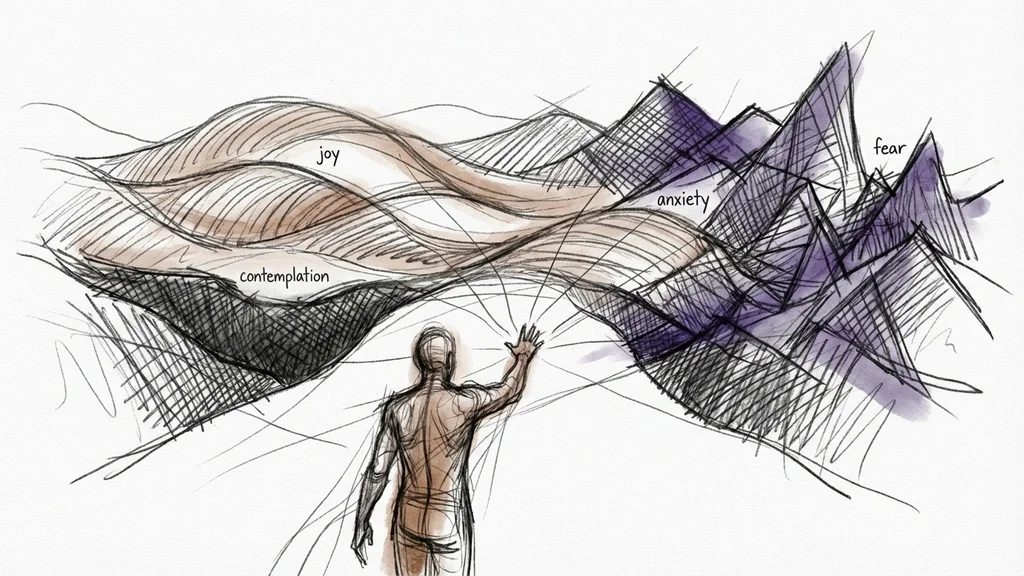
An important part of the state of detachment is the ability to observe both the positive and negative aspects of our lives. When we can objectively look at both the good and the bad within us, we arrive at a third state that embraces both. This inner balancing gives us the possibility of connecting with our authentic essence and accepting ourselves completely, with all aspects of our lives.
How We Can Practice the State of Detachment in Our Lives
This state can be reached through a variety of techniques and practices, such as meditation, mindfulness, yoga, conscious breathing, and others that we can integrate into our daily routine.
One of these exercises involves imagination and visualization, where we imagine observing our thoughts and emotions as if they were simple sequences on a mental screen. Through this practice, we learn to position ourselves outside our reactions and to be neutral witnesses to our own experience.
These practices can help us reduce mental noise and relax our nervous system, allowing us to connect with the present and experience inner peace. They can also help us free ourselves from anxiety, stress, and tension and regain mental clarity and emotional balance.
This ability to detach and witness our own thoughts and emotions offers us a different perspective on our lives. We can look at our experiences with an objective eye and analyze them with greater clarity. In this way, we can free ourselves from anguish and fears and focus more easily on the positive and inspirational aspects of our lives.
It is said that when we can observe both the good and the bad within us, we arrive at a third state that embraces both. This inner balance gives us the possibility of connecting with our authentic essence and accepting ourselves completely, with all aspects of our lives.
Here Is a Practical Exercise:
To reach this triad of awareness, I am sharing a simple exercise that you can integrate into your daily routine.
- Sit comfortably in an upright position, with your feet placed at a comfortable distance, and make sure your back is straight. Close your eyes and begin to focus on your breathing.
- Now imagine all your negative thoughts, states, emotions, and feelings as dark shadows around you. Without analyzing or judging them, begin to automatically send them toward the center of the Earth, at the base of your feet. Notice how they drain through you and move toward the center of the earth.
- Now imagine all your positive thoughts, states, emotions, and feelings as bright lights around you. Without analyzing or judging them, begin to automatically send them upward toward the sky. You can even raise your hands to consciously guide them. Notice how they pass through you and move toward the sky.
- Now that you have access to two reservoirs of states, the positive and the negative, and you are in a state of deep detachment and relaxation, capable of embracing both your light side and your shadow, you can begin to integrate both into a single state and observe them as a simple spectator, simultaneously. You can imagine a very large circle in which you are positioned at the center, and the edge beautifully touches both the center of the earth, where you sent the negative thoughts, and the sky, where the positive thoughts reside. You can mentally expand this sphere to include both the darkness and the light. The purpose of the exercise is to have an image in which you can experience both “reservoirs of states” at once.
- In this state of neutral observation, feel how you connect with the present, with yourself, and with the state of detachment. Observe this state like a child, without judgments or interpretations. Notice with curious eyes how you feel in this new perspective, with the earth at your feet and the sky above you, being part of this complete experience.
- Remain in this state as long as you wish, allowing yourself to experience inner peace and mental clarity. Each practice session will bring you closer to reaching the state of detachment and relaxation, and over time, you will become more skilled at accessing this state with ease, whenever you need it.
The exercise is based on the practice of observing thoughts and emotions without engaging in them, allowing you to release them and achieve a state of deep detachment and relaxation. Through consistent practice, you can begin to gain greater awareness of your own thoughts and emotions and manage them more effectively.
The Journey Toward Inner Peace
The state of detachment can be a precious tool on our journey toward inner peace and emotional balance. By cultivating this ability, we can free ourselves from daily agitation and tension and connect with our authentic essence. Despite the challenges and agitation around us, we can find peace and harmony in the depths of our inner stillness.
Through the regular practice of the state of detachment, we can develop a deeper awareness of our own experience and manage our thoughts and emotions more effectively. This can help us improve our interpersonal relationships, make wiser decisions, and increase our overall well-being.
It is important to understand that the state of detachment does not mean avoiding or denying our emotions, but rather understanding and managing them in a healthy and balanced way. Through regular practice of this state, we can experience the profound benefits of a more conscious and balanced life.
“When you see things as they are and not as you want them to be, that is true freedom.”
— Anthony de Mello
And finally, a short story:
In a world tangled in its own duality, there is always room for a story that brings light into our souls and guides us toward simple yet profound wisdom.
According to the story, Siddhartha Gautama, who would later become the Buddha, spent many years searching for understanding and liberation from suffering and ignorance. Eventually, he chose to meditate under the Bodhi tree, near the modern city of Bodh Gaya, India, determined to remain in a state of meditation until he attained enlightenment.
During his meditation, Siddhartha was confronted by the temptations and fears of the demon Mara, the personification of temptations and obstacles on the path to enlightenment. Mara sent an army of demons and tried to prevent Siddhartha from reaching the state of enlightenment. However, Siddhartha, now the Buddha, remained firm and unwavering in the face of these temptations.
At one point, Mara challenged the Buddha by asking who supported him in his claim to attain enlightenment. In response, the Buddha touched the earth with his right hand, calling upon the Earth to be witness to his enlightenment. This gesture, known as the “Bhumisparsha Mudra,” was an act of deep trust and determination in the pursuit of enlightenment and a fundamental connection with the present.
This gesture symbolizes liberation from illusions and from attachment to the duality of life, including good and evil. By touching the earth, the Buddha brought clarity and balance to his mind, transcending duality and finding a state of detachment and inner wisdom.
The gesture also represents an integration of both aspects of human existence: light and darkness, good and evil. Instead of allowing himself to be overwhelmed by the forces of duality, the Buddha chose to integrate them into his deeper understanding of reality and found peace in the midst of conflict.
In that moment, Mara and his entire army of demons vanished, and the Buddha attained enlightenment under the Bodhi tree. This experience marked the moment when the Buddha became enlightened and gained a profound understanding of human nature and the path toward liberation from suffering.
The legend of the Buddha and the demon Mara under the Bodhi tree reminds us that each of us faces our own inner struggles on the path toward enlightenment and liberation. Yet, through courage, trust, and determination, we can overcome all obstacles and reach inner enlightenment and profound peace.
This symbolic story underscores the inner power of the individual to face their own fears and illusions and to reach enlightenment and liberation. The Buddha’s wisdom and his mastery over his own thoughts and emotions helped him overcome all obstacles and attain enlightenment under the Bodhi tree.
It is a remarkable example of the spiritual journey of humankind and of our potential for self-discovery and liberation.