The Properties of Perception
Our own perceptions have always been at the foundation of both our personal and professional decisions. Understanding the perceptual process will always give us an advantage in decision-making.
Perceptions are complex sensory processes and, at the same time, primary images containing all the information about the concrete properties of objects and phenomena, under the condition of their direct action upon our sensory receptors. They play a very important role in our development, both psychological and physical.
Each of us is born with the ability to sense certain properties of objects. But as we mature psychologically, we and our environment help us develop our sensory processes. These become increasingly complex and expansive. In other words, the more information we have about our environment, the better we can become aware of it.
But there is also the unconscious perception of the environment, which takes in information about objects and phenomena and classifies, organizes, and stores it. This cognitive processing can be accessed through self-knowledge exercises, hypnosis, meditation, and so on.
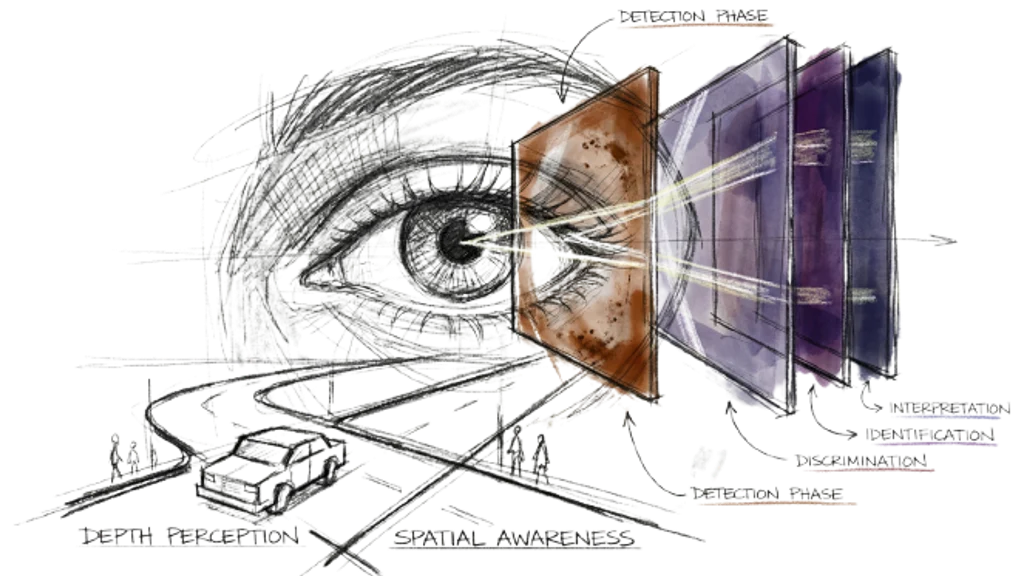
Every act of perception involves going through several phases:
- Detection is the first phase of the perceptual act and consists of noticing and becoming aware only of the presence of the stimulus in the perceptual field, without being able to say anything about its characteristics.
- Discrimination is the second phase and involves distinguishing the stimulus from the background and noticing the features that set it apart from similar ones.
- Identification refers to bringing together, into a unified image, the information obtained and relating it to the corresponding perceptual model, thus enabling recognition of what is being perceived.
- Interpretation is the final phase, which goes beyond the perceptual process itself and consists of verbal integration, establishing the significance of the perceived object or phenomenon, and the possibility of using it in activity.
A brief example:
When a person is behind the wheel, they must consciously perceive the distance between their car and other vehicles (distance perception), they must distinguish the road from the ground, distinguish people from cars… (object separation), and they must perceive that both they and, most likely, other vehicles are in motion (motion perception).
At the same time, they are capable of recognizing their position relative to the road, their position in the car, the car’s position on the road, and the position of other objects in the environment (localization). They are also capable of distinguishing certain colors in the environment, certain distinctive characteristics of a group of objects, and grouping them independently.
For perceiving time, the individual uses three reference systems: the physical and cosmic system, the biological system, and the socio-cultural system.
However, there are also perceptual illusions, which are a series of perceptions that distort certain aspects. For example, a person of average height may appear tall among shorter people and may seem much smaller among those who are significantly taller.