Mathematical Knot Theory and the Metaphor of Human Unity: How We Can Use Knowledge from Mathematics to Understand the Connection Between Us
In a world where technology and science evolve rapidly, exploring connections between seemingly different fields can offer surprising perspectives and valuable wisdom.
In this article, we aim to bring to the forefront two seemingly distinct fields — mathematical knot theory and human psychology — and to examine how they can be connected to illuminate the complexity and beauty of human interactions.
Mathematical knot theory, initially developed to understand the structure and behavior of complex systems, offers a unique way of representing and analyzing networks of connections. By defining and studying nodes and the links between them, mathematicians can analyze how information and influence propagate within a system and can identify critical points and vulnerabilities.
On the other hand, in the human sphere, the concept of unity is essential for understanding how interpersonal relationships and communities form and evolve. At the heart of this unity lies the recognition that we are interconnected and interdependent — that our individual actions and experiences have an impact on the whole.
In this context, we aim to explore how mathematical knot theory can offer a valuable lens for understanding and illustrating human connections.
How can we use knowledge from mathematics to understand and explore the connections that unite us as people?
Exploring knot theory and human connections
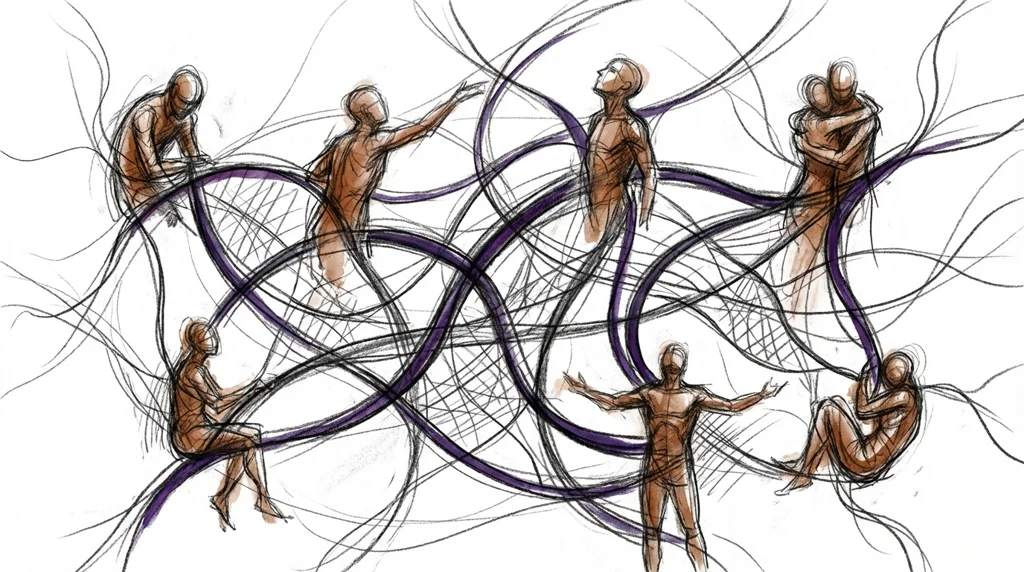
In mathematics, a node represents a point of intersection in a graph (a set of objects), and the links between nodes are lines connecting these points to one another. Similarly, in our daily lives, each individual can be seen as a node, and the interactions and relationships between us are represented by those connecting lines. From friends and work colleagues to our family and community, we are all linked in a complex and interconnected whole.
In knot theory, a key idea is that knots can be manipulated and transformed through a series of operations while still maintaining their essential properties. Similarly, in the philosophical or spiritual concept of unity, there is a fundamental unity or interconnection that exists in the universe.
One way to interpret this metaphorically is to consider each individual as a unique “node” within the fabric of existence.
While we may seem separate on the surface, we are all interconnected in profound ways, just like the interwoven strands of a knot. Just as knot theory explores how knots can be transformed and undone, the concept of unity suggests that through self-awareness, understanding, and compassion, we can transcend the illusion of separation and recognize our inherent unity with all beings and the universe.
Connections between knot theory and human psychology
Psychology shows us that each individual is complex and unique, with their own traits, experiences, and perspectives. In this sense, we can view each person as a “node” in the fabric of life. Although we often perceive ourselves as separate entities, there is a subtle network of connections and interdependencies that bind us to one another. This interconnection is highlighted by relational psychology, which emphasizes how our relationships with others shape our identity and influence our behavior and emotions.
How do these human connections affect us? Human psychology offers us a profound perspective on how social interactions and our relationships influence our emotional and mental state. For example, a study by Nicholas Christakis and James Fowler showed that a person’s well-being can be influenced by the well-being of those around them, thus creating a network of emotional influence.
Human unity: a whole greater than the sum of its parts
The concept of human unity suggests that, despite appearances, we are all fundamentally connected. Each individual contributes to the social and cultural fabric of the society in which they live. For example, the concepts of empathy and solidarity show us that we are capable of feeling and connecting with the experiences of others, thus reflecting this underlying unity.
The hypothesis that we are all interconnected and that we form a whole greater than the sum of its individual parts is a fascinating and profound concept. Although it may seem abstract at first, there are numerous examples from our daily lives that demonstrate this human unity. From solidarity and mutual support in our local community to viral phenomena and global trends that influence us all, we are all part of something greater.
Understanding this human unity can have a profound impact on how we relate to others and to the world around us. By cultivating compassion, mutual respect, and solidarity, we can create more equitable and inclusive societies, where each individual is valued and supported in their pursuit of happiness and personal fulfillment.
Practical tips for integrating knot theory into our human interactions
- Be aware of your connections: Consider how your actions and words can have an impact on those around you. Pay attention to how you relate to others and how these interactions can influence their emotional and mental state.
- Cultivate empathy and understanding: Try to see the world from others’ perspectives and put into practice your capacity to empathize with their experiences. Be open to listening and understanding the needs and emotions of those around you.
- Support and build positive relationships: Invest in your interpersonal relationships and encourage an atmosphere of mutual support and trust. Offer support and encouragement to those around you and build relationships based on respect and understanding.
Mathematical knot theory offers us not only a deeper understanding of our human connections, but also the opportunity to explore and cultivate these connections in a conscious and beneficial way for everyone.
In a world full of complexity and rapid change, recognizing our human unity can serve as an essential guide for navigating our relationships and for creating a more harmonious and empathetic society.
By understanding and integrating concepts from knot theory into our daily interactions, we can contribute to building a stronger and better-connected network of human relationships. In this way, we can enjoy the benefits of a more united and supportive community, where each individual feels valued and supported.
Ultimately, by learning to recognize and appreciate our human connections, we can improve our quality of life and fulfill our potential to live in harmony and mutual understanding.
Let us strive to cultivate this human unity in every aspect of our lives and to contribute to building a more connected and empathetic world for everyone.